
The answer
But did you read the question?

Before the Easter break, I posted an old photograph and asked a couple of questions. It’s something I had previously done, a few years ago on another platform, and the results were the same both times, with answers that were exactly what I was expecting really. Not content with just a brief glance at the photo, followed by a generic answer, people drilled right down to the details, commenting in particular on the spelling of the word “flavor”, and suggesting that this could indicate a photo taken in the USA, but then questioning whether mention of the King would preclude that and place the shop firmly somewhere in the British Empire instead. Others suggested that the turn of phrase (“grand value”) might locate the shop in Ireland.
Speaking as a translator and interpreter, it was interesting to see the answers demonstrate the lengths we will go to, as linguists, to track down the right answer, and I’m pleased to have given you pause for thought, for a few minutes, before you went back to finishing whatever you were doing. Given the talents on display across our community, I expect a few of you were probably hand-crafting Easter eggs, or placing disciples on the top of your own simnel cakes, or possibly running the length of Hadrian’s Wall before tea.
The actual answer is that the shop was in Hull, so most definitely in Yorkshire, England. Just typing that sentence made me wonder how many other Hulls there are out there, and now I know that there are 9 Hulls in the USA, and 13 other places worldwide (although none of the others glory in the full name of Kingston-upon Hull).
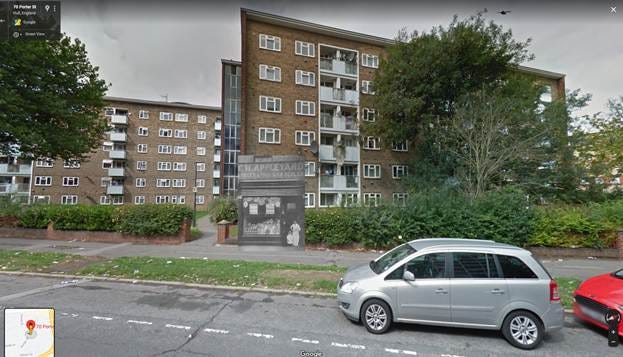
The photo was taken in 1906, meaning that the King in question would have been Edward VII, and the shop was in Porter Street, not far from Hull Railway Station. The area itself has changed completely since it was bombed in both World Wars (a historical footnote being that the bombing in the First World War was carried out by Zeppelins, at a time when nobody on the ground would have expected bombs to fall from the sky. How dreadful).
Linguistically, it’s interesting to think how the rules have changed over the years. These days the shopkeeper would probably be getting insulted online for his dreadful spelling, but given that posters like those would probably have been mass-produced, most people would, presumably, have been perfectly comfortable with it.
Having written this, I’ll turn the computer back off and go to do something completely different now. Today is surprisingly warm and, after looking out of the window at my garden all day, I think it’s time to get out there and do something a bit more productive in horticultural terms, even if the something in question is nothing more than a little bit of cutting along, perhaps, with pricking out some seedlings that seem to have got very excited by the sunshine too.
Post illustrated with the photo I posted on Friday, back on Substack for its second outing in less than a week, superimposed on a Street View of the same location now.
Thank you for reading!
I appreciate that this is only a brief post, and hardly worthy of the time you’ve taken to read this far, but if you’ve enjoyed reading something I’ve written (some of my posts are more interesting, honest!), then you also have the option to simply buy me a cup of tea (contributions may in fact be used to buy cheese, but I won’t tell if you don’t ask).
I know for Australia, and this would've been the case in much of the British Empire that spellings such as -our, -ise and -isation did not become settled as standard until the mass release of the Shorter Oxford English Dictionary in the 1920s, which coincided with the expansion of primary and secondary education and therefore greater literacy. Before that, -or spellings were just as common as -our throughout the Empire. That explains why it's the "Labor" and not "Labour" Party in Australia (founded in 1894). Actually, Australian newspapers used -or spellings for decades after the 1920s, with the last one changing to -our being Melbourne's the Age in 2001.
So that would explain why the 1906 sign in Hull had "Flavor"