
Postcards
Pictures of Home

A few days ago, Rachel Mae wrote a post in favour of postcards which is well worth a read if you’ve got a moment.

I replied to say that I have a couple of postcards of my house, something which, at first glance, looks extremely cool. It is indeed quite cool, but not to the extent that it appears at first since it seems that, back in ye olden times, people made postcards of just about anything, particularly since postcards were used to send brief messages to others in much the same way as we might send something these days, using our favourite messaging platform.
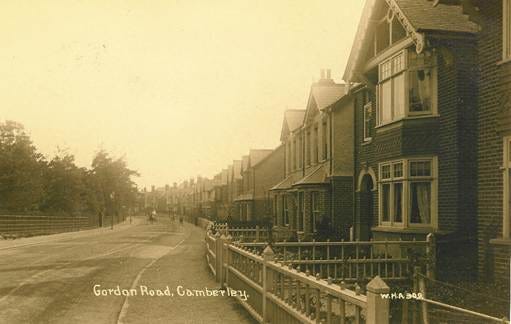
This postcard was sent, from Camberley, the town where I live, in 1915. Like many towns in many parts of the world, development followed the railways, ribbon-like, alongside the newly laid tracks, out into suburban areas where, previously there had been nothing.
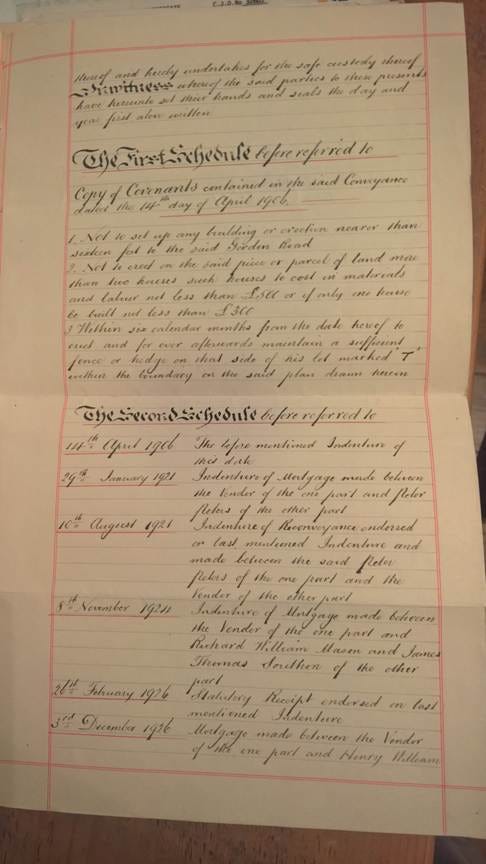
The house itself was built in 1906. The plot on which it, and its very similar-looking neighbour, stand is 50 feet wide, and the original deed states that, if one house were to be built, then it should cost in materials not less than £300 or (as happened in this case) if two houses were built, not less than £500. The reason for this was that, apparently, builders could use surplus materials from one house in the construction of the other. There are curious differences between the houses which presumably were discussed at length at the time, such as one having cavity walls, and the other solid ones, and the staircase in one house is steeper than in the other, presumably to save on wood.
At some point, not long after it had been built, the house had acquired a name, Daphne (its neighbour became Wiston), although it was renamed later, becoming Cartref instead.
Getting back to the postcard for a while. One day back in 2006, when the light was similar, I popped outside and took a photo from pretty much the same spot.
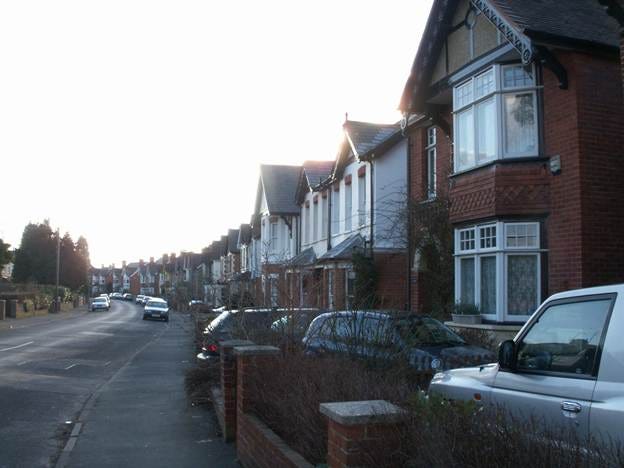
Apart from there being more cars in the later picture, it’s a remarkably similar view except for that fact that there is one extra house that has managed to slot itself into a gap between two blocks of semi-detached houses at some point. I have no idea when. The other interesting thing is the second house along in this photo which we were told, when we moved in, had started to be built before the World War I, but had then been left unfinished until after the end of that particular conflict. In fact that clearly wasn’t the case, since it’s in the postcard too.
Speaking of the Great War (what a name!), the back of the postcard is interesting too.
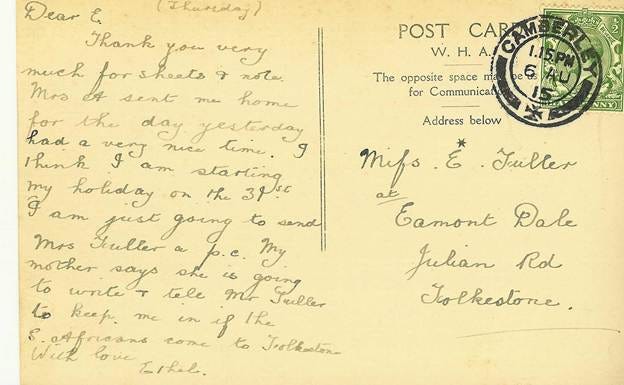
I have no idea who Ethel is, but presumably she had some sort of connection to Gordon Road, because otherwise why on earth would you choose to send that postcard. She talks about her upcoming trip to Folkestone, and the fact that her mother is going to write and tell Mr Fuller to keep her in if the South Africans come to Folkestone.
Of course, in 1915, Folkestone was a very busy port for troops being sent to and from France. Presumably the South Africans in question were on their way from their homes, many thousands of miles away, to the killing fields of France where, for example, the 4th South African Infantry Regiment had a casualty rate of 74% in one week in July 1916, during the battle of the Somme. They had much more to worry about than whether Ethel would set eyes on them.
Moving on. The next postcard was taken from further down the road, looking east with the house just about visible before the bend.
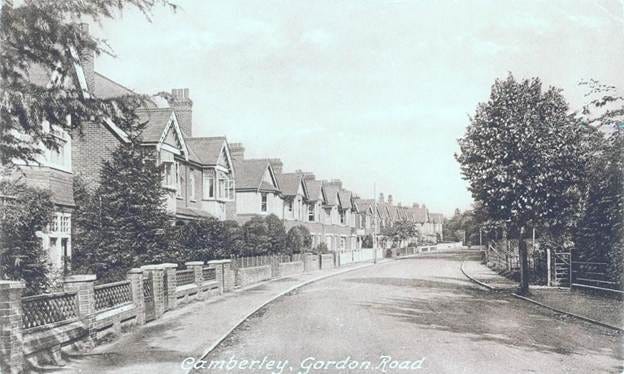
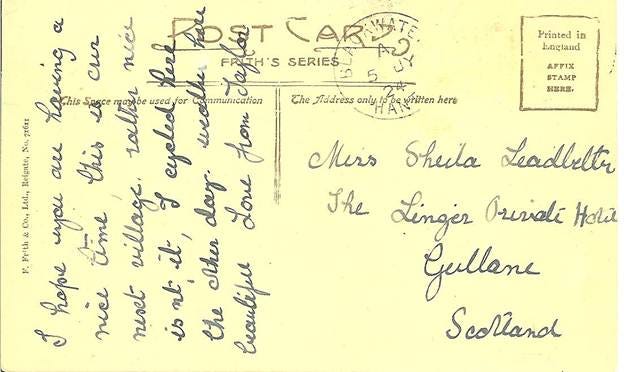
It rather looks as if Taylor is actually on holiday in the area. The postcard is sent from Blackwater (just across the county boundary in Hampshire) and describes Camberley as “our next village, rather nice isn’t it”. I don’t know that Camberley was ever a village, and I suspect that if Taylor went into the town centre nowadays she might find another way to describe it. But the view in the postcard is, once again, instantly recognisable.
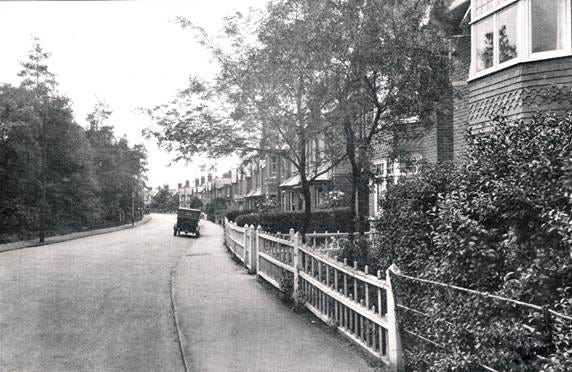
The final old picture I have of the house is undated although it’s obviously later. The fence, still shiny and new in the first image, is now rather the worse for wear, and the trees have grown. The house that was missing from the earlier postcard has now been built and, in the front garden, there’s a rose standing tall. I have nothing to prove it, but I like to think that the rose we still have in front of the house, which is almost as tall as the place itself, is the same one, or at least a descendent of the original. I’ll never know though.
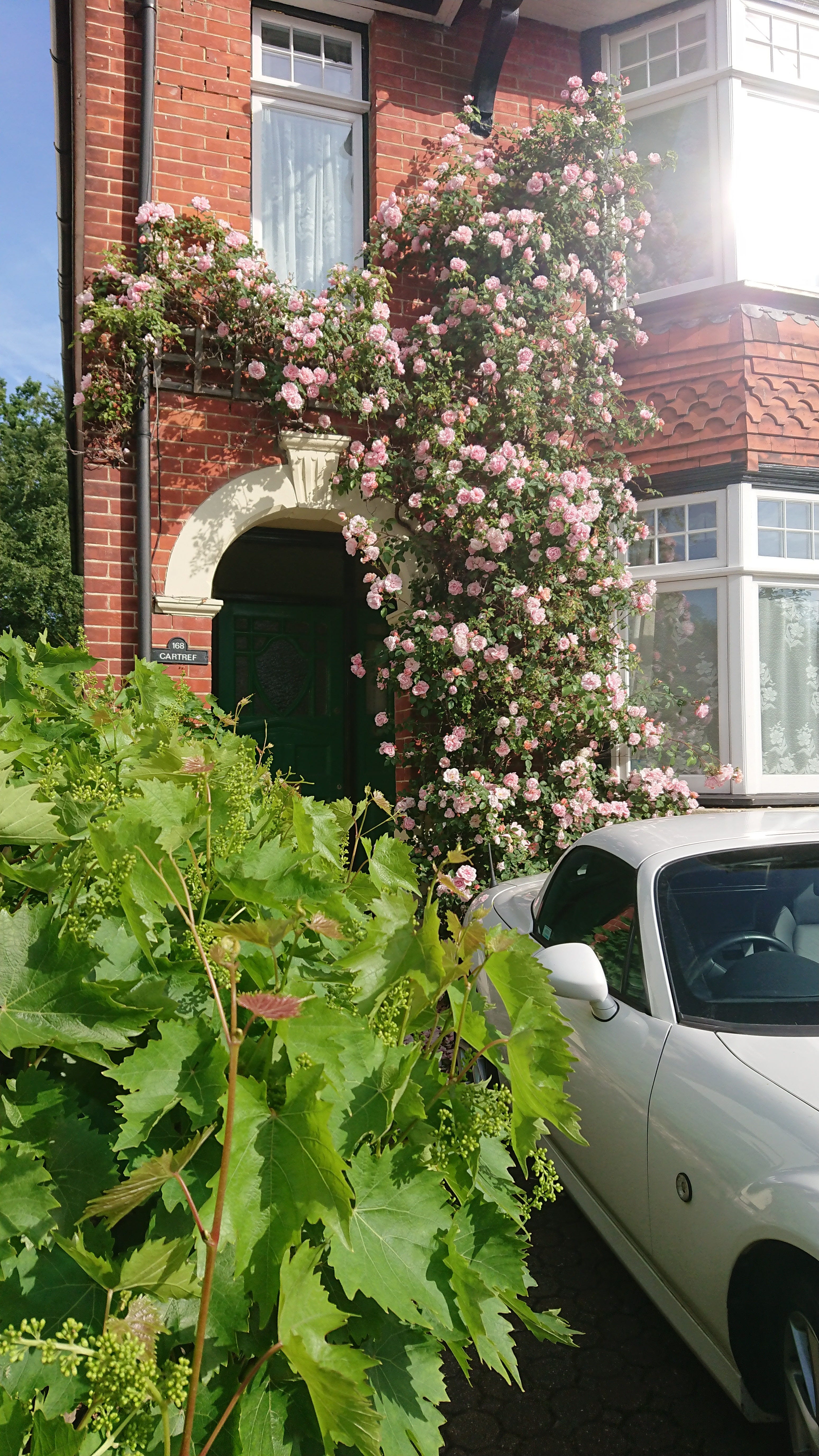
The house has other stories to tell, such as when it got renumbered in 1972, or when, later that year, the council asked people if they would like to name the road so that it had a single name from one end to the other (Gordon Road, rather than Upper Gordon Road, Middle Gordon Road, Gordon Road, and Gordon Avenue). People said no to the renaming, but the renumbering went ahead, but only on one side of the road which has confused delivery drivers ever since (140, renumbered to 168, is opposite 129, while 167 is nearly 400 metres away further up the road).
Finally, though, here’s a photo of some old wallpaper I found, about a decade ago, hidden under an old shelf. I wonder if Ethel ever knew it. Perhaps she even saw it being hung, maybe when the house was decorated for the very first time.
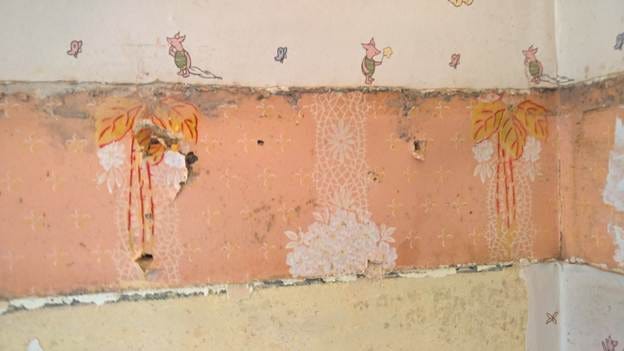
Who knows…
Thank you very much for reading these words about my home. If, quite understandably, the thought of handing over your hard-earned cash to subscribe is too much to contemplate, but you’ve enjoyed reading something I’ve written, then you also have the option to simply buy me a postcard (contributions may in fact be used to buy stamps, but I won’t tell if you don’t ask).
This is great, thank you for sharing! (And for the link)