
Old signs
Making you hungry and thirsty since forever

Anybody who has had the misfortune to read too many of my posts will have realised that I’ve got a bit of a thing for old signs, particularly ones known as ghost signs, which are vestiges of old painted adverts, or the names of shops which, in many cases, vanished a very long time ago.
In French, they often refer to them as “vieilles publicités”, essentially “old adverts”, and my interest goes beyond the strictest English-language interpretation of that term to include metal and indeed carved signs too. I’m also happy to take photos of places that are actually still in business, such as this one which I took only a week ago, in the middle of Troyes. It is directly opposite the cathedral, and indeed the tower in the background has peregrine falcons nesting in it. I’ve been there on all three of my visits to the town so far this year, but I haven’t seen the birds yet, although I did ask in the church if they’re still around and was reassured that they are indeed. Maybe I’ll be luckier next time.
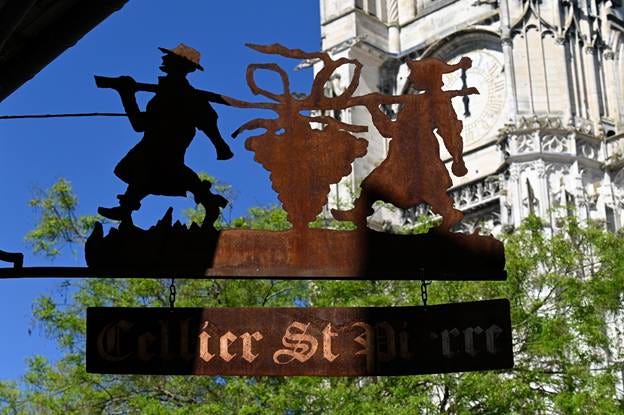
The wall the sign above is attached to hints at the activity that used to be carried out on the site before it became an up-market wine shop.
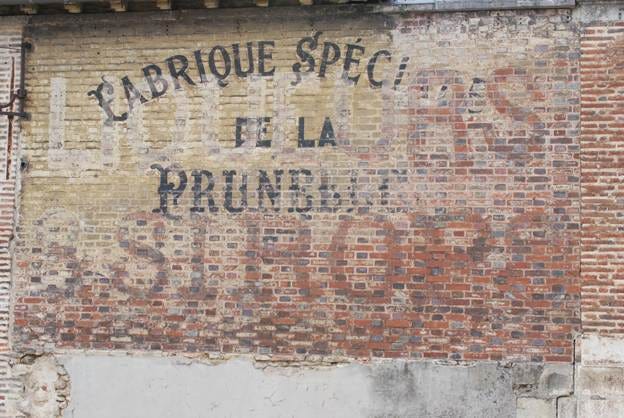
I took this photo about 15 years ago. Sadly, the sign has now been restored, with the lettering in black now much clearer, while the less visible lettering underneath has almost completely vanished.
If you turn your back on the cathedral and head a few hundred metres up the road in the general direction of the town centre, there’s a narrow street with a café in it, as well as a very good Lebanese restaurant which I could happily digress into a post about, but I’ll try to keep focused and not do that. Getting back to the café, luckily, it has a room on the first floor, from which you can look out of the window and admire the building opposite, which was once used to make biscuits.
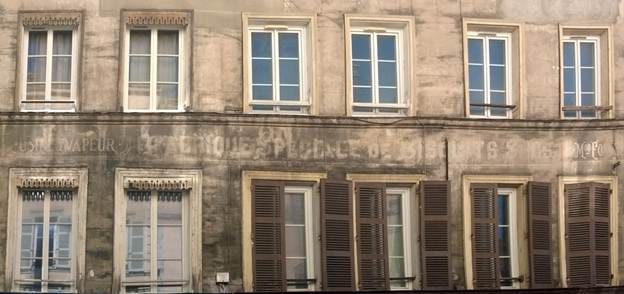
It’s almost impossible to photograph the entire thing in one go, so this photo is an amalgamation of several, as you can see if you look closely – in real life, nobody makes windows quite that shape, but since they aren’t the focus of the image, I don’t think anybody will tell me off too much for the fact they’re rather wibbly-wobbly.
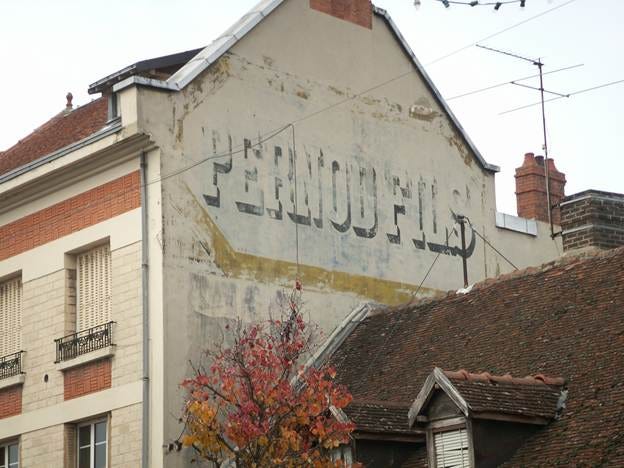
A couple of weeks ago, I was doing a job where the subject of pastis came up (the topic we were interpreting mentioned Marseille quite a lot). There are, naturally, several different brands of that particular beverage, and the drink’s fans will very enthusiastically support their favourite, while simultaneously talking down the other brands on the market. Outside France, Pernod is (arguably) the best known, and the next ghost sign was snapped (back in 2005 apparently) slightly further out of Troyes, on the main road through Sainte-Savine. You can just about see it from the church where I got married in fact, although as far as I remember, no pastis was consumed on that day.
If you do a left and then a right, and then continue your journey south-westwards along the N77, you soon reach the village of Saint-Germain where your thoughts of drink will be encouraged to turn to Dubonnet. I don’t know how many old Dubonnet adverts can still be found across France (I’ve got 18 on Flickr, and plenty more on my computer), but I do know that it’s a lot. Most of them feature large quantities of blue paint, unlike this one which is, I suspect, rather older.
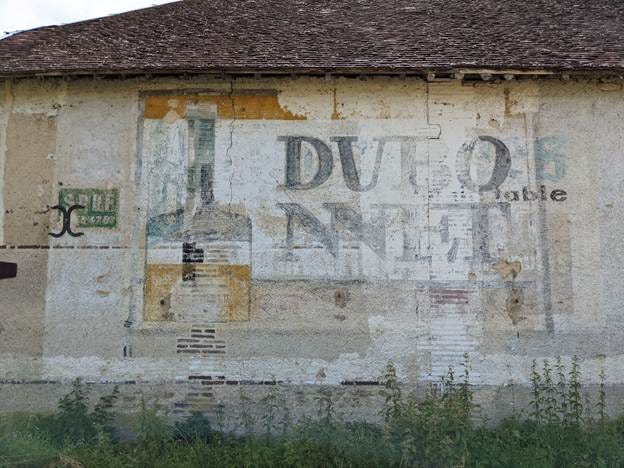
Indeed, if you turn around and head back in a vaguely easterly direction, until recently it wouldn’t have taken you long to find several blue ones, in Lusigny-sur-Barse for example, or the one shown here, on a bend in the road a few miles further on, in what is basically a hamlet with a restaurant on the way to the lakes, at Le Ménilot. Sadly, this building has now been renovated and the sign has essentially vanished.
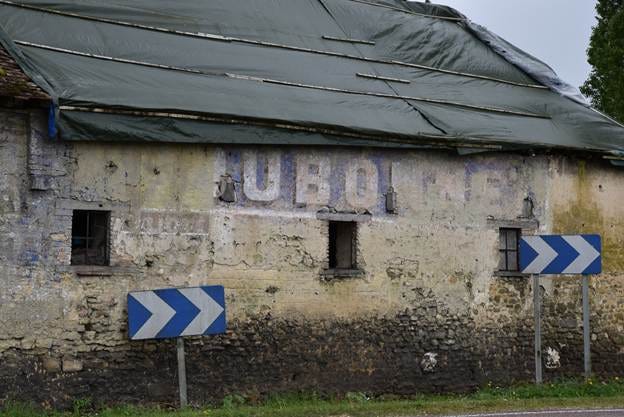
When I say “sadly”, that is of course a moot point. It’s much better for buildings to be restored and retained than just to be left crumbling, especially when they’re by a main road and look like they could, at any moment, collapse onto the carriageway.
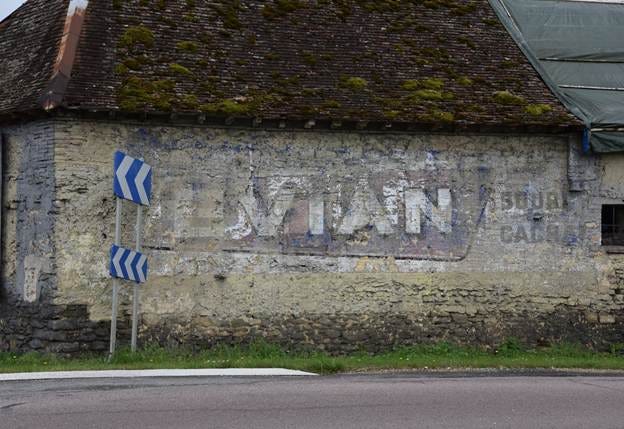
Anyway, back to ghosts. The same crumbling building in Le Ménilot doesn’t just encourage you to drink booze. On the other end of the same wall, there is a sign for Evian, a mineral water which, according to advertising claims they wouldn’t get away with these days, had positively miraculous health properties.
Before the A5 autoroute was built from Paris towards Dijon, traffic between the French capital and Troyes used to take the route national 19, now downgraded to route départementale 619. It’s an utterly featureless road. Long, boring, straight bits, interspersed with “coroner’s corridors”, those overtaking lanes in the middle which cars can (and do) use heading in either direction, sometimes playing chicken with traffic coming the other way towards them. The only buildings breaking up the monotony being places where cars, buses and lorries used to be able to stop to fill up (vehicles and their passengers), but which closed years ago and are now nothing but ugly blots on the landscape.
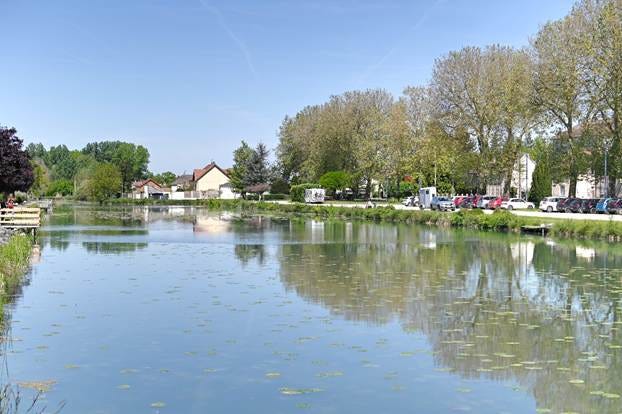
I had decided to head to Méry-sur-Seine, a small town on the Seine river (perhaps not too surprisingly, given its name), and also a place the Canal de la Haute-Seine passes through, with a very attractive basin which is very good for photographs of reflections, and people fishing, and generally a nice place to have a walk along the towpath. The Canal in question was never actually finished, despite Napoléon (yes, that one) decreeing in 1805 that it should be fully navigable within 6 years. It lasted rather longer than he did, but it never really got any further than Troyes, and finally met its Waterloo with large sections filled and transformed into roads at different points from 1956. Despite that, there are still some sections visible in the centre of Troyes itself.
I digress – something I’m quite good at.
I decided I wouldn’t head to Méry along the boring road but would take the old road (the d78 rue Saint-Savinien) that runs essentially alongside the Seine. My reward was this absolutely gorgeous rusty metal sign in a blink-and-you’ll-miss it village called Rilly-Sainte-Syre.
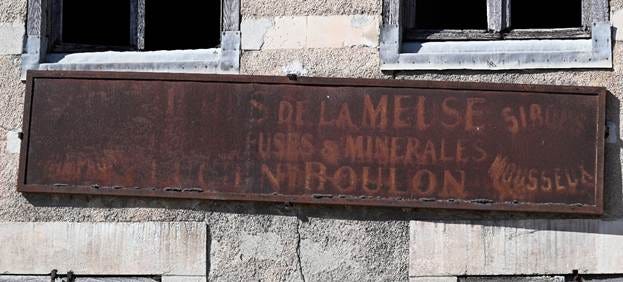
If there had been even the smallest chance that it could have fallen off the wall and into my boot, then it would have done but, luckily for posterity, it’s a fairly substantial piece of work, and I suspect that the reason it’s still there is that it would take quite a bit of effort to get it off the wall.
Still smiling at my good luck, I bumbled a little further along the same road, and in an equally small place (with a restaurant), Droupt-Saint-Marie, I spotted this on a bend. I have no idea what the first half of the sign says, but the second half clearly says Eau de vie. The water of life. I haven’t been able to find anything out about it at all, but I was very happy to see it.
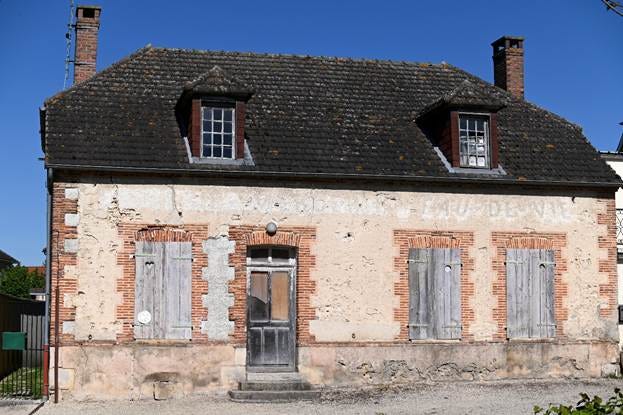
Méry itself had several ghost signs, as well as the aforementioned photogenic canal. When wife was a girl, her grandfather used to take her with him when he went fishing in the canal basin there, a fact she had completely forgotten until we reached it, at which point her memories came flooding back, which was sweet.
I’ll end this post with a photo which isn’t of an old sign, just to prove that I do take other things as well.
Thank you so much for reading.
If, quite understandably, the thought of subscribing is too much to contemplate, but you’ve enjoyed perusing something I’ve written, then you also have the option to simply buy me a roll of film for my camera (contributions may in fact be used to buy larger memory cards, but I won’t tell if you don’t ask).
The iron pegs driven into stone would make extraction of "de la Meuse" difficult indeed.
I hate to say it, but I think AI scanning technology (sometimes now used in radiography and similar) now exists to plumb what lies just beneath the surface, and might help with deciphering some images in your vast collection.